What Is the Most Effective Birth Control? Comparing Your Options
If you’re trying to prevent pregnancy, one of the most common questions is: What is the most effective birth control? There isn’t one contraceptive method that is perfect for everyone. The best option depends on how effective you want it to be, whether you want hormones, how often you want to think about contraception, whether […]
Contents
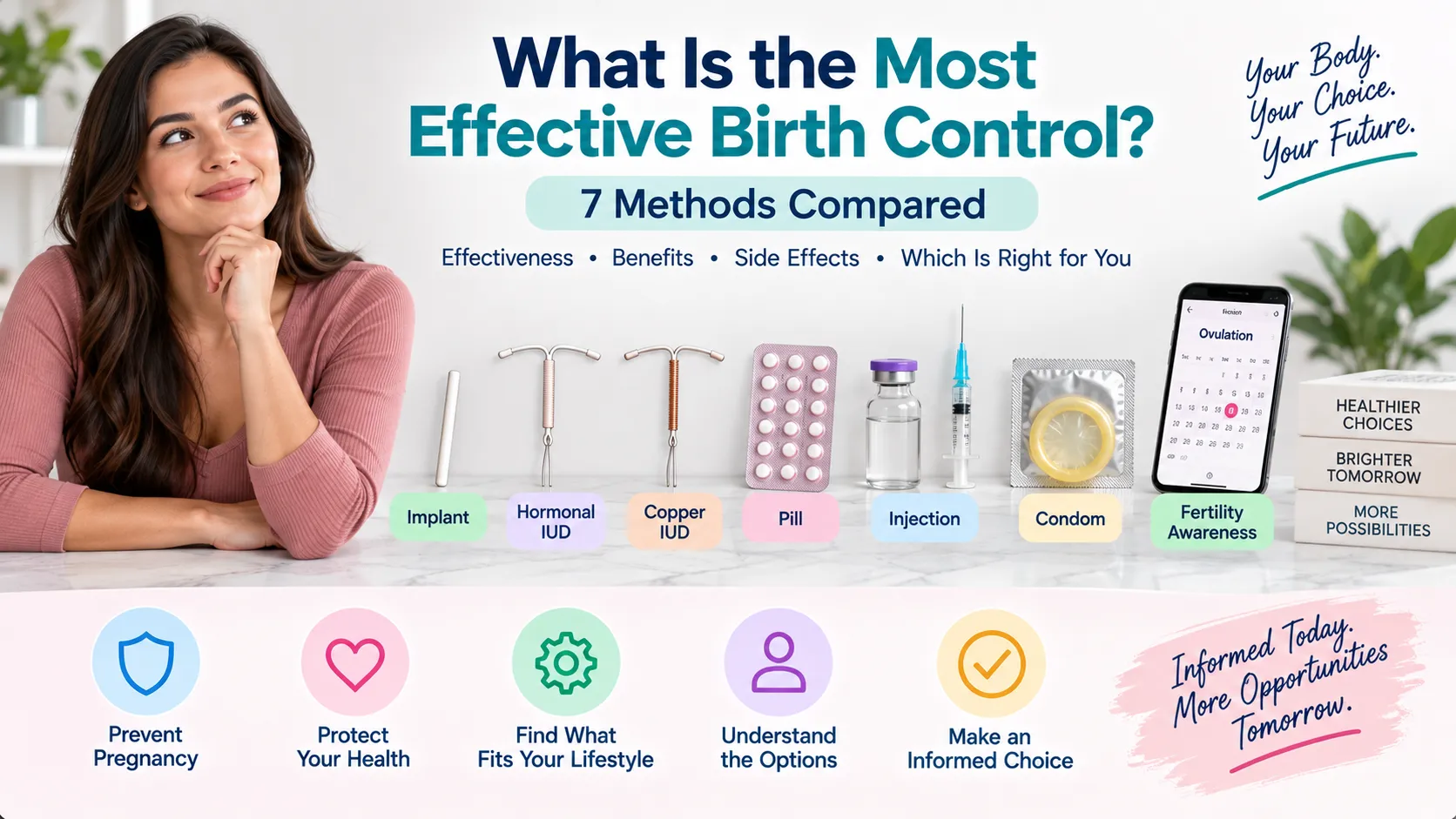
If you’re trying to prevent pregnancy, one of the most common questions is: What is the most effective birth control?
There isn’t one contraceptive method that is perfect for everyone. The best option depends on how effective you want it to be, whether you want hormones, how often you want to think about contraception, whether you also need protection from sexually transmitted infections (STIs), your health history and whether you want pregnancy in the future.
Some methods are much less dependent on remembering to use them correctly. Long-acting reversible contraceptives such as implants and intrauterine devices (IUDs) are among the most effective reversible options. Condoms are less effective for pregnancy prevention with typical use, but they have an important advantage: they can also reduce the risk of many STIs, including HIV.
So the “best” birth control isn’t necessarily the method with the highest effectiveness number. It’s the method that provides the protection you need and that you can use correctly and consistently.
Quick Answer: Which Birth Control Is Most Effective?
For reversible contraception, implants and IUDs are among the most effective methods because they don’t require you to remember to take or use something every time you have sex.
According to current CDC contraceptive information, typical-use failure rates are approximately:
| Method | Typical-use failure rate* |
|---|---|
| Implant | 0.1% |
| Hormonal IUD | 0.1–0.4% |
| Copper IUD | 0.8% |
| Injection | 4% |
| Birth-control pill | 7% |
| External condom | 13% |
| Fertility-awareness methods | 2–23% |
*These figures are from CDC contraceptive guidance and describe typical use in the United States. Effectiveness can vary according to the specific method and how it is used.
Important: No contraceptive method other than abstaining from sex involving sperm entering the vagina provides absolute pregnancy prevention.
What Does “Birth Control Effectiveness” Actually Mean?
Birth-control effectiveness can be confusing because you may see two different numbers for the same method.
Perfect use
This describes how well a method works when it is used exactly as instructed every time.
Typical use
This reflects real-world use, including situations such as:
- Forgetting pills
- Using condoms incorrectly
- Missing injections
- Not following fertility-awareness instructions
- Delaying or incorrectly using a contraceptive method
This distinction is important because some methods require regular user action.
For example, an IUD remains in place once inserted, whereas a pill needs to be taken regularly. Therefore, the effectiveness seen in everyday life can differ considerably between methods.
1. Birth Control Implant
The contraceptive implant is a small flexible rod placed under the skin of the upper arm by a healthcare professional.
It releases a progestin hormone and is designed to provide long-lasting contraception.
The CDC currently lists a typical-use failure rate of about 0.1% for the implant.
Why is it so effective?
The implant doesn’t depend on remembering a pill every day or using contraception during every sexual encounter.
Potential advantages
- Highly effective
- Long-acting
- Reversible
- Doesn’t require daily action
- No need to interrupt sex to use it
Possible disadvantages
Some users experience changes in menstrual bleeding patterns. Hormonal side effects can also occur.
A healthcare professional can help determine whether an implant is appropriate for you.
2. Hormonal IUD
A hormonal IUD is a small device placed inside the uterus by a healthcare professional.
It releases a progestin hormone and provides long-lasting, reversible contraception.
The CDC lists typical-use failure rates of approximately 0.1–0.4%, depending on the device.
WHO also recognizes IUDs as highly effective, long-acting and reversible contraceptive options.
Potential benefits
- Very effective
- Long-lasting
- Reversible
- Low-maintenance
- Does not require daily contraception
Some hormonal IUD users also experience lighter periods, although individual responses vary.
Does a hormonal IUD protect against STIs?
No.
IUDs prevent pregnancy but do not protect against STIs. If STI protection is needed, condoms should also be considered.
3. Copper IUD
The copper IUD is a non-hormonal contraceptive option.
It uses copper to interfere with sperm and fertilization and can provide long-term pregnancy prevention.
The CDC lists a typical-use failure rate of about 0.8% for the copper IUD.
WHO describes the copper IUD as a hormone-free contraceptive option and notes that it can remain effective for many years, depending on the product.
Why do some people choose a copper IUD?
It may appeal to people who:
- Don’t want hormonal contraception
- Want long-term contraception
- Don’t want to remember contraception every day
- Want a reversible method
One consideration is that copper IUDs can cause heavier or more painful periods in some users, particularly during the early months.
4. Birth Control Injection
The contraceptive injection uses a progestin hormone and is administered periodically.
The CDC lists a typical-use failure rate of approximately 4%.
Its effectiveness can be affected by whether injections are received on schedule.
Potential advantages
- Doesn’t require daily pills
- Effective contraception
- Private and relatively low-maintenance between injections
Potential disadvantages
Menstrual changes and other hormonal side effects can occur.
The injection may also not be the preferred option for everyone, so discussing your medical history with a healthcare professional is important.
5. Birth Control Pills
Birth-control pills are among the most widely recognized contraceptive methods.
Depending on the formulation, pills may contain estrogen and progestin or progestin alone.
The CDC currently lists a typical-use failure rate of approximately 7% for oral contraceptive pills.
The reason typical-use effectiveness is lower than that of implants and IUDs is partly that pills require regular use.
Missing pills can reduce contraceptive protection.
Advantages
Depending on the formulation, pills may:
- Provide effective pregnancy prevention
- Regulate menstrual bleeding
- Reduce menstrual symptoms for some users
- Be reversible
Important
Not every pill is suitable for every person.
Certain medical conditions, medications and risk factors can affect which contraceptive methods are appropriate. This is why individual medical advice matters when choosing hormonal contraception.
6. Condoms
Condoms are different from most other contraceptive methods because they can help with both pregnancy prevention and STI prevention.
WHO states that condoms, when used correctly and consistently, are highly effective at reducing transmission of many STIs, including HIV, and also help prevent unintended pregnancy.
The CDC lists a typical-use failure rate of approximately 13% for external condoms.
Why are condoms still important?
Because pregnancy isn’t the only concern associated with sex.
A person using an IUD, implant or pill may still need condoms if they want protection against STIs.
WHO describes condoms as the only currently available multipurpose prevention technology against HIV, STIs and unintended pregnancy.
This means “most effective birth control” and “best protection during sex” aren’t always the same thing.
7. Fertility Awareness-Based Methods
Fertility-awareness methods involve identifying the fertile and less-fertile parts of the menstrual cycle.
Depending on the specific method, this can involve tracking:
- Menstrual cycles
- Cervical mucus
- Basal body temperature
- Other fertility signs
The CDC reports a broad range of typical-use failure rates—approximately 2–23%—because different fertility-awareness methods and user practices have different effectiveness.
This method requires learning the technique correctly and consistently identifying fertility patterns.
It is particularly important not to assume that simply knowing the approximate date of ovulation guarantees protection from pregnancy.
Our article What Is Ovulation? Signs, Symptoms, Timing & Pregnancy Chances explains why ovulation timing can vary and why the fertile window extends beyond a single day.
What About Withdrawal?
Withdrawal, sometimes called the pull-out method, involves removing the penis from the vagina before ejaculation.
It can reduce the chance of pregnancy compared with ejaculation inside the vagina, but it is less reliable than many other contraceptive methods.
One reason is that pre-ejaculate may sometimes contain sperm.
As we explain in our article Can You Get Pregnant From Precum? Here’s What You Need to Know, pregnancy is possible even without ejaculation inside the vagina.
Withdrawal also does not protect against STIs.
If avoiding pregnancy is especially important, consider using a more reliable contraceptive method.
Which Birth Control Is Best Without Hormones?
If you want contraception without hormones, options include:
Copper IUD
One of the most effective long-term non-hormonal options.
Condoms
Hormone-free and also useful for STI prevention.
Fertility-awareness methods
Do not use hormones but require careful and consistent tracking.
Withdrawal
Hormone-free, but considerably more dependent on correct use and generally less reliable than highly effective contraceptive methods.
The right choice depends on your priorities.
If you want very high pregnancy-prevention effectiveness without hormones, the copper IUD is an important option to discuss with a healthcare professional.
Which Birth Control Protects Against STIs?
Condoms are the key contraceptive option when STI prevention is also important.
Hormonal birth control, implants, injections and IUDs prevent pregnancy but do not protect against STIs.
For people who may be exposed to STIs, using condoms consistently and correctly can provide an important additional layer of protection.
This is especially relevant because a person can have an STI without obvious symptoms.
For more information, see our Safer Sex & STIs content on TheSexxEducation.
Can You Use Two Birth Control Methods Together?
Yes.
Using two methods can provide different types of protection.
For example:
Condom + hormonal contraception
can provide pregnancy prevention through hormonal contraception while the condom also helps reduce STI risk.
This is sometimes called dual protection.
Using condoms alongside another effective contraceptive can be particularly useful when STI exposure is possible.
What If Birth Control Fails?
No method is perfect.
A condom can break or slip. A pill can be missed. A contraceptive method can be used incorrectly.
If unprotected sex occurs or contraception may have failed, emergency contraception may be an option.
WHO states that emergency contraception can be used within five days after unprotected sex, depending on the method, and generally works better the sooner it is used. A copper IUD is the most effective emergency contraceptive option and can also continue to provide ongoing contraception.
You can read our detailed guide:
What Is Emergency Contraception? How Does It Work?
If you’ve had a recent contraceptive failure, don’t delay seeking advice from a qualified healthcare professional or pharmacist because timing matters.
Does Birth Control Affect Future Fertility?
For many reversible contraceptive methods, fertility can return after stopping the method, although the timing can vary depending on the specific contraceptive.
The important distinction is between reversible contraception and permanent contraception.
IUDs and implants are long-acting but reversible.
Sterilization procedures such as vasectomy and female sterilization are intended to be permanent.
WHO includes both temporary/reversible and permanent contraceptive methods among family-planning options.
If future pregnancy is important to you, make that part of your conversation with your healthcare professional before choosing a method.
How Do You Choose the Right Birth Control?
Instead of asking only:
“Which birth control is best?”
ask:
1. How important is maximum pregnancy prevention?
If avoiding pregnancy is your highest priority, highly effective long-acting methods may be worth considering.
2. Do you want hormones?
If not, options such as condoms and the copper IUD may be considered.
3. Do you need STI protection?
If yes, condoms are important.
4. Do you want something long-term?
Implants and IUDs can provide long-term reversible contraception.
5. Do you want to avoid daily medication?
An implant or IUD doesn’t require daily pill-taking.
6. Do you want pregnancy in the future?
Discuss reversible versus permanent methods.
7. Do you have any medical conditions?
Some contraceptives may not be appropriate depending on your medical history or medications.
WHO’s 2025 Selected Practice Recommendations for Contraceptive Use provide current guidance on safely starting, continuing and managing different contraceptive methods.
Birth Control Comparison at a Glance
| Method | Hormonal? | Long-acting? | STI protection? | Typical-use effectiveness |
|---|---|---|---|---|
| Implant | Yes | Yes | No | Very high |
| Hormonal IUD | Yes | Yes | No | Very high |
| Copper IUD | No | Yes | No | Very high |
| Injection | Yes | No | No | High |
| Pill | Yes/depends on type | No | No | High |
| External condom | No | No | Yes | Moderate |
| Fertility awareness | No | No | No | Variable |
| Withdrawal | No | No | No | Lower |
Effectiveness figures vary by method and source; the CDC’s current typical-use estimates are the basis for the numerical figures above.
Common Birth Control Myths
Myth 1: The most expensive birth control is the most effective.
Not necessarily.
Effectiveness depends on the method and how consistently it is used—not simply its cost.
Myth 2: Birth control protects against STIs.
Most birth-control methods do not.
Condoms are the major exception because they can reduce the risk of many STIs as well as pregnancy.
Myth 3: You can’t get pregnant while you’re having your period.
Pregnancy can still occur during or around a period because ovulation timing varies and sperm can survive for several days.
Read:
Can You Get Pregnant During Your Period? What Are the Chances?
Myth 4: Emergency contraception causes abortion.
WHO states that emergency contraceptive pills work primarily by preventing or delaying ovulation and do not interrupt an established pregnancy.
Frequently Asked Questions
What is the most effective birth control?
Implants and IUDs are among the most effective reversible contraceptive methods. Their effectiveness is high because they require little ongoing user action.
What is the most effective non-hormonal birth control?
The copper IUD is one of the most effective long-term non-hormonal contraceptive options. Condoms are another hormone-free option and have the additional benefit of reducing STI risk.
What birth control has the lowest failure rate?
The implant and hormonal IUD have among the lowest typical-use failure rates in current CDC data.
Is the birth-control pill effective?
Yes. When used correctly, the pill can be highly effective. However, typical-use effectiveness is lower because people may miss pills or take them incorrectly.
Are condoms effective at preventing pregnancy?
Yes. Condoms can prevent pregnancy when used correctly and consistently, but their real-world effectiveness is lower than that of long-acting methods. They also provide STI protection, which most other contraceptives do not.
Can you use condoms with birth control pills?
Yes. Using condoms alongside hormonal contraception can provide pregnancy prevention while also reducing STI risk.
Can birth control stop ovulation?
Some hormonal contraceptives work partly or primarily by preventing ovulation. The exact mechanism depends on the contraceptive method.
Can you get pregnant while using birth control?
Yes, although the chance depends on the method and how it is used. No contraceptive method is 100% effective.
What should I do if a condom breaks?
If pregnancy is possible and you don’t want to become pregnant, emergency contraception may be an option. It should generally be considered as soon as possible because effectiveness depends partly on timing.
Does emergency contraception protect against STIs?
No. Emergency contraception is designed to reduce pregnancy risk after unprotected sex or contraceptive failure. It does not protect against STIs.
The Bottom Line
The most effective reversible birth-control methods include implants and IUDs.
But effectiveness isn’t the only factor that matters.
If you want:
- Maximum pregnancy prevention: consider an implant or IUD.
- Hormone-free long-term contraception: consider a copper IUD.
- STI protection: condoms are important.
- A method you control yourself: condoms, pills or other user-controlled methods may be preferable.
- Emergency protection after unprotected sex: emergency contraception may help when used promptly.
The best contraceptive method is ultimately one that fits your health, preferences, lifestyle, reproductive plans and need for STI protection.
If you’re unsure which option is appropriate, talk with a qualified healthcare professional rather than choosing solely based on an effectiveness ranking.
Authoritative Sources
- WHO — Family planning/contraception methods
- WHO — Contraception overview
- WHO — Condoms
- WHO — Emergency contraception
- WHO — Selected Practice Recommendations for Contraceptive Use, 4th edition
- CDC — Contraception and Birth Control Methods
Editorial recommendation for TheSexxEducation: Because contraception is a YMYL health topic, add “Medically Reviewed By,” “Last Updated,” and an author/reviewer bio to this article. Also, keep the effectiveness table clearly labeled as typical-use estimates, because figures can vary by country, method formulation and guideline source.
Advertisement · Continue Reading Below

No comments yet — be the first to comment.
Leave a comment
Comments are reviewed before they appear.