PMS vs PMDD: What’s the Difference?
Many people experience physical or emotional changes before their period. Bloating, breast tenderness, cramps, headaches, fatigue, irritability, mood changes and food cravings can all occur during the days or weeks before menstruation. These symptoms are commonly associated with premenstrual syndrome (PMS). But for some people, premenstrual symptoms are much more severe and can significantly interfere […]
Contents
Many people experience physical or emotional changes before their period. Bloating, breast tenderness, cramps, headaches, fatigue, irritability, mood changes and food cravings can all occur during the days or weeks before menstruation.
These symptoms are commonly associated with premenstrual syndrome (PMS).
But for some people, premenstrual symptoms are much more severe and can significantly interfere with work, school, relationships or everyday activities. This condition is known as premenstrual dysphoric disorder (PMDD).
So, what is the difference between PMS and PMDD?
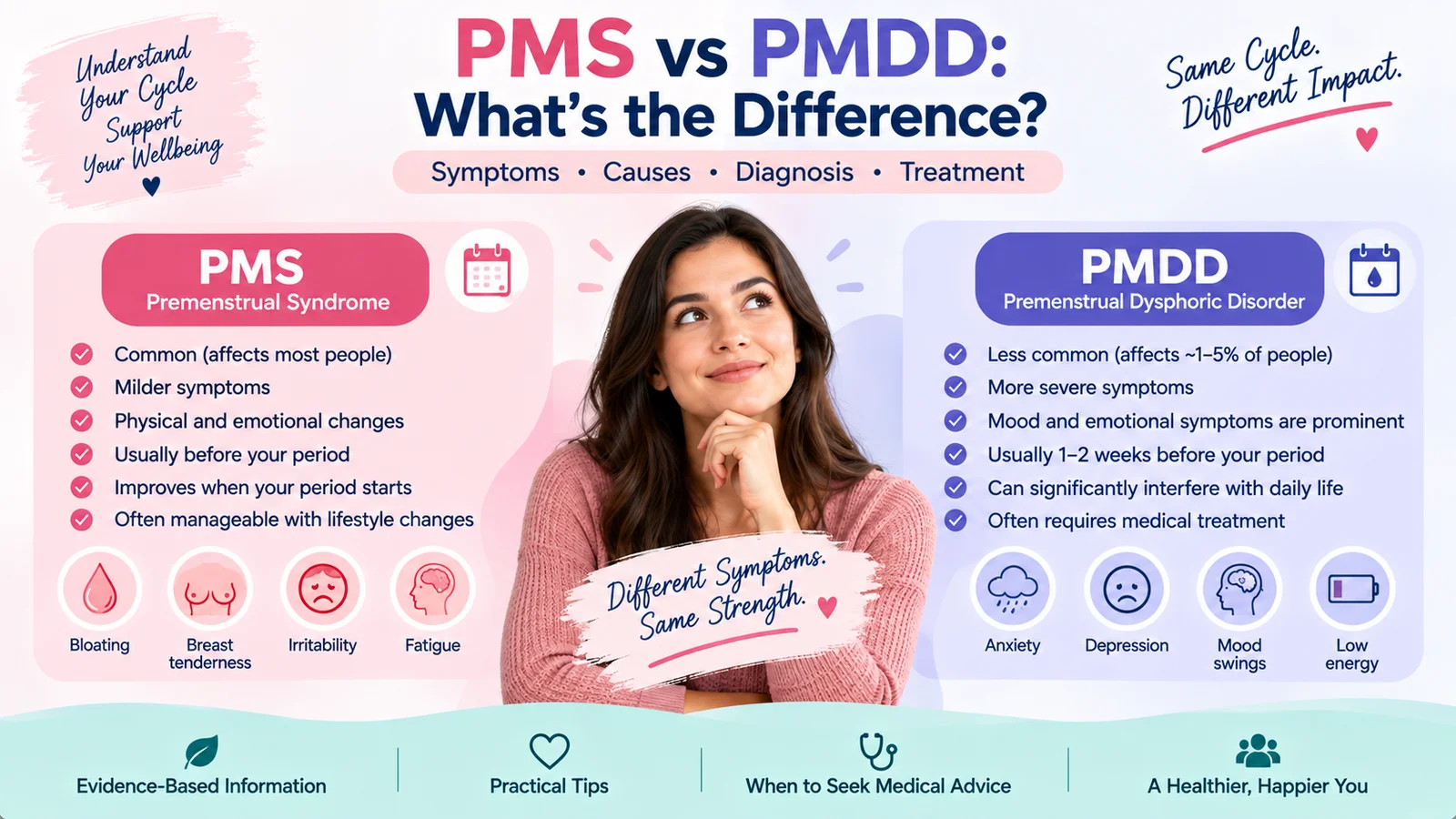
The biggest difference is severity and impact on daily life. PMDD involves severe premenstrual symptoms, particularly emotional and behavioral symptoms, that follow a recurring menstrual-cycle pattern and cause substantial impairment. PMS can also cause significant symptoms, but PMDD represents a more severe clinical condition.
PMS vs PMDD: The Quick Difference
| Feature | PMS | PMDD |
|---|---|---|
| Full name | Premenstrual syndrome | Premenstrual dysphoric disorder |
| How common? | Very common | Much less common |
| Symptoms | Physical, emotional and behavioral | Physical, emotional and behavioral |
| Mood symptoms | May occur | Usually prominent and severe |
| Effect on daily life | Mild to significant | Often substantially disruptive |
| Timing | Usually before the period | Usually 1–2 weeks before the period |
| Improvement | Usually improves when the period starts | Usually improves within a few days after the period begins |
| Diagnosis | Based largely on symptom pattern and clinical assessment | Requires specific symptom criteria and prospective tracking |
| Treatment | Lifestyle measures, medication or both depending on severity | Often requires medical treatment, which may include SSRIs, hormonal treatment and/or CBT |
The exact diagnostic criteria and prevalence estimates vary by definition and study population, but PMDD is consistently much less common than PMS.
What Is PMS?
Premenstrual syndrome (PMS) describes a combination of physical and emotional symptoms that occur before a menstrual period.
According to the U.S. Office on Women’s Health, more than 90% of women report experiencing some premenstrual symptoms, although not everyone has symptoms severe enough to meet criteria for PMS.
The NHS also describes PMS as symptoms that can occur in the weeks before a period and notes that symptoms can vary considerably from person to person and from month to month.
Common PMS symptoms include:
Physical symptoms
- Bloating
- Breast tenderness
- Headaches
- Abdominal cramps
- Backache
- Fatigue
- Acne
- Constipation or diarrhea
- Muscle or joint discomfort
Emotional and behavioral symptoms
- Irritability
- Mood swings
- Anxiety
- Feeling emotional
- Low mood
- Difficulty concentrating
- Sleep changes
- Appetite changes
- Food cravings
- Reduced interest in sex
Not everyone experiences the same combination of symptoms.
For example, one person may mainly experience bloating and breast tenderness, while another may experience irritability, fatigue and mood changes.
What Is PMDD?
Premenstrual dysphoric disorder (PMDD) is a more severe premenstrual disorder that can cause intense emotional, behavioral and physical symptoms.
The Office on Women’s Health describes PMDD as similar to PMS but more serious, with symptoms such as severe irritability, depression and anxiety that can significantly affect daily life.
The NHS similarly notes that PMDD symptoms can interfere with work, social activities and relationships.
PMDD is not simply someone being “extra sensitive” before their period. It is a recognized medical condition and can require treatment.
What Are the Symptoms of PMS?
PMS can produce a broad range of symptoms.
Physical symptoms
You might experience:
- Bloating
- Cramps
- Headaches
- Breast tenderness
- Fatigue
- Back pain
- Muscle or joint pain
- Acne
- Digestive changes
- Changes in appetite
Emotional symptoms
These can include:
- Irritability
- Anxiety
- Sadness
- Mood swings
- Crying
- Feeling tense
- Difficulty concentrating
- Changes in sleep
- Reduced interest in sex
PMS symptoms usually follow a predictable pattern and improve after menstruation begins.
What Are the Symptoms of PMDD?
PMDD can include many of the same physical symptoms as PMS, but the emotional and behavioral symptoms are generally much more severe.
According to the Office on Women’s Health, symptoms can include:
- Severe irritability or anger
- Anxiety or tension
- Depression or hopelessness
- Mood swings
- Frequent crying
- Panic attacks
- Feeling overwhelmed or out of control
- Reduced interest in normal activities or relationships
- Difficulty concentrating
- Low energy
- Changes in appetite
- Sleep problems
- Bloating
- Breast tenderness
- Headaches
- Muscle or joint pain
The impact on everyday life is one of the most important differences between typical PMS and PMDD.
Someone with PMDD may find it difficult to work, study, socialize, maintain relationships or perform normal daily activities during the symptomatic part of the menstrual cycle.
PMS vs PMDD: Why Does Timing Matter?
Timing is extremely important.
PMS and PMDD are cyclical conditions. Symptoms typically appear during the latter part of the menstrual cycle, after ovulation and before menstruation.
They then improve after the period begins.
The Office on Women’s Health explains that PMS symptoms commonly occur during the one to two weeks before a period and generally resolve within a few days after menstruation starts.
PMDD follows a similar pattern.
The NHS reports that PMDD symptoms commonly begin around one or two weeks before the period and improve within a few days after menstruation starts.
This cyclical pattern is important because depression or anxiety that occurs throughout the entire month may have a different underlying explanation, even if those symptoms become worse before menstruation.
Is PMDD Just Severe PMS?
This is a common question.
PMDD is closely related to PMS, but it is not simply a label for having a particularly bad month of PMS.
PMDD has specific diagnostic criteria and is characterized by a combination of symptoms, including prominent mood-related symptoms and significant impairment.
The American College of Obstetricians and Gynecologists recognizes PMS and PMDD as premenstrual disorders and provides specific clinical guidance for their evaluation and management.
A person can have severe PMS symptoms without necessarily meeting the diagnostic criteria for PMDD.
That’s why severity alone isn’t enough to self-diagnose PMDD.
How Common Is PMDD?
PMS is extremely common, while PMDD is considerably less common.
The Office on Women’s Health estimates that less than 5% of women of childbearing age experience PMDD.
However, prevalence estimates vary depending on how PMDD is defined and diagnosed.
A 2024 systematic review and meta-analysis involving more than 50,000 participants found a pooled prevalence of 3.2% for confirmed PMDD and 7.7% for provisional diagnoses. When the researchers restricted their analysis to community-based studies using confirmed diagnoses, the estimate was 1.6%.
This difference is one reason it is better to avoid saying that exactly one specific percentage of people have PMDD.
What Causes PMS and PMDD?
Researchers don’t have one simple explanation for either condition.
Hormonal changes during the menstrual cycle appear to play an important role.
After ovulation, levels of reproductive hormones change. Some people appear to be more sensitive to these normal hormonal fluctuations than others.
The NHS notes that PMDD may be related to increased sensitivity to normal changes in estrogen and progesterone during the menstrual cycle.
Research from the National Institute of Mental Health has also investigated how reproductive hormones may trigger mood symptoms in people with PMDD and suggests that abnormal sensitivity to normal hormone changes may be involved.
Serotonin, a chemical involved in mood regulation, may also play a role.
However, PMDD is not simply caused by having “too many” or “too few” hormones.
The problem may involve how the brain and body respond to normal hormonal changes.
How Is PMS Diagnosed?
There is no single blood test that can confirm PMS.
Instead, healthcare professionals look at:
- What symptoms you experience
- When symptoms occur
- How severe they are
- How long they last
- Whether they interfere with daily life
- Whether symptoms improve after menstruation begins
- Whether another condition could explain them
Keeping a symptom diary for at least two menstrual cycles can be particularly useful.
Mayo Clinic recommends recording symptoms, when they begin and when they disappear to establish whether there is a predictable premenstrual pattern.
This can also help distinguish PMS from other conditions whose symptoms may worsen around menstruation.
How Is PMDD Diagnosed?
PMDD requires a more specific assessment.
The diagnosis is based on the pattern and severity of symptoms rather than a single blood test.
A person generally needs to experience at least five symptoms, including at least one prominent mood-related symptom.
These can include:
- Depressed mood
- Anxiety or tension
- Marked mood swings
- Irritability or anger
- Reduced interest in usual activities
- Difficulty concentrating
- Low energy
- Changes in appetite
- Sleep changes
- Feeling overwhelmed or out of control
- Physical symptoms such as breast tenderness, bloating, headaches or muscle/joint pain
The Office on Women’s Health states that five or more PMDD symptoms, including one mood-related symptom, are required for diagnosis.
Importantly, symptoms should show a repeating relationship to the menstrual cycle.
Prospective daily symptom tracking over at least two cycles is an important part of confirming PMDD rather than relying only on memory. Research reviews and clinical guidance support prospective symptom monitoring for this reason.
Why Tracking Your Period and Symptoms Can Help
If you’re wondering whether you have PMS or PMDD, start tracking your symptoms.
Record:
Day 1: First day of menstrual bleeding
Then note each day:
- Mood
- Anxiety
- Irritability
- Energy
- Sleep
- Appetite
- Cramps
- Headaches
- Bloating
- Breast tenderness
- Concentration
- Interest in normal activities
- How symptoms affect work, school or relationships
The goal isn’t just to see whether you have symptoms.
It’s to identify when they occur and when they disappear.
The National Institute of Child Health and Human Development recommends tracking menstrual dates as well as flow, pain and changes in mood or behavior.
You can also read our guide to What Is Ovulation? Signs, Symptoms, Timing & Pregnancy Chances to better understand where ovulation fits within the menstrual cycle.
PMS Treatment: What Can Help?
Treatment depends on the severity and symptoms.
For mild PMS, lifestyle measures may be enough.
These can include:
- Regular physical activity
- Adequate sleep
- A balanced diet
- Stress-management techniques
- Relaxation exercises
- Mindfulness or meditation
- Reducing alcohol
- Avoiding smoking
The NHS recommends regular exercise, adequate sleep, a balanced diet and stress-management approaches as measures that may help PMS symptoms.
Pain relievers such as ibuprofen or naproxen may help certain physical symptoms when medically appropriate.
For more troublesome PMS, healthcare professionals may consider treatments such as hormonal contraception, cognitive behavioral therapy (CBT) or antidepressants.
PMDD Treatment: What Can Help?
Because PMDD can be significantly disruptive, treatment may require more than lifestyle changes.
The ACOG Clinical Practice Guideline on premenstrual disorders recognizes several evidence-based approaches, including:
- Pharmacological treatment
- Hormonal treatment
- Psychological counseling
- Exercise
- Nutritional approaches
- Patient education
- Self-help strategies
ACOG also emphasizes that some people may benefit from a multimodal approach, meaning more than one treatment strategy may be used.
SSRIs
Selective serotonin reuptake inhibitors (SSRIs) are an important treatment option for PMDD.
Evidence summarized in a recent Cochrane review indicates that SSRIs probably reduce overall premenstrual symptoms in people with PMS or PMDD.
Depending on the medication and individual circumstances, they may be prescribed continuously or during part of the menstrual cycle.
Hormonal contraception
Some combined oral contraceptives can help certain people with PMS or PMDD.
The Office on Women’s Health notes that the FDA has approved a combined pill containing drospirenone and ethinyl estradiol for PMDD.
However, hormonal contraception isn’t appropriate for everyone, so the choice should be individualized with a healthcare professional.
Cognitive behavioral therapy
CBT may help people manage emotional symptoms, thoughts, stress and the effects of PMDD on everyday life.
The NHS lists CBT among the main treatment approaches for PMDD.
Lifestyle measures
Exercise, adequate sleep, balanced nutrition and stress management may also help reduce symptoms, although they should not be treated as a replacement for medical care when PMDD is severe.
Can Exercise Help PMS or PMDD?
Regular physical activity may help some people manage premenstrual symptoms.
The NHS recommends regular exercise for both PMS and PMDD.
Exercise may also support overall physical and mental wellbeing.
If you’re interested in the connection between exercise and sexual health, see our Fitness & Wellness section.
The important point is that exercise isn’t a guaranteed treatment for PMDD. Someone with severe symptoms may still require professional assessment and treatment.
PMS vs PMDD and Mental Health
One of the most important distinctions is that PMDD can involve severe mood symptoms.
Someone may experience:
- Intense irritability
- Severe anxiety
- Depression
- Hopelessness
- Panic attacks
- Feeling out of control
- Loss of interest in normal activities
These symptoms can be mistaken for a mental health condition that exists independently of the menstrual cycle.
At the same time, someone can have an existing condition such as depression or anxiety that becomes worse before their period.
ACOG notes that depression and anxiety can have symptoms that resemble PMS and may worsen before or during menstruation.
This is why the timing and pattern of symptoms matter so much.
When Should You See a Doctor?
You don’t have to simply “put up with” severe PMS symptoms.
Consider speaking with a healthcare professional if:
- PMS symptoms interfere with your daily activities
- Symptoms affect work or school
- Symptoms are damaging relationships
- You experience severe mood changes every month
- You feel unusually depressed or anxious before your period
- Symptoms are becoming worse
- Lifestyle changes aren’t helping
- You think you may have PMDD
The NHS specifically recommends seeking medical advice if you think you may have PMDD or if PMS symptoms are affecting your daily life.
PMDD and Suicidal Thoughts: When to Get Immediate Help
PMDD can involve severe depression and suicidal thoughts.
This should never be dismissed as “just PMS.”
If you are experiencing thoughts of suicide, self-harm or harming someone else, seek urgent mental-health or emergency medical help immediately. Don’t wait for your next period or attempt to manage the situation alone.
The NHS and Office on Women’s Health both specifically identify suicidal thoughts as a serious PMDD symptom requiring urgent help.
PMS vs PMDD: A Simple Example
Imagine two people experience symptoms seven days before their periods.
Person A
They experience:
- Mild bloating
- Breast tenderness
- Some irritability
- Mild fatigue
The symptoms are uncomfortable but they can continue working, studying and socializing.
This pattern may be consistent with PMS.
Person B
They experience:
- Severe irritability
- Depression
- Anxiety
- Sleep problems
- Difficulty concentrating
- Loss of interest in normal activities
The symptoms become severe enough that they repeatedly miss work and withdraw from relationships, then improve after menstruation begins.
This pattern may warrant assessment for PMDD.
The difference isn’t simply the number of physical symptoms. The severity, emotional symptoms, cyclical pattern and impact on daily functioning all matter.
PMS vs PMDD: Common Myths
Myth 1: PMDD is just an excuse for mood swings.
False.
PMDD is a recognized medical condition with specific diagnostic criteria and can significantly impair daily functioning.
Myth 2: Everyone with PMS has PMDD.
False.
PMS is common, while PMDD is much less common.
Myth 3: PMDD means your hormones are abnormal.
Not necessarily.
Research suggests that people with PMDD may have an increased sensitivity to normal hormonal changes rather than simply having abnormal hormone levels.
Myth 4: PMS and PMDD can be diagnosed with a blood test.
Usually, no.
Diagnosis relies heavily on symptom history and the timing of symptoms. Prospective symptom tracking can be particularly important for PMDD.
Myth 5: Severe period-related mood symptoms should always be ignored until the period starts.
False.
If symptoms are severe or affecting your quality of life, medical evaluation is appropriate.
Frequently Asked Questions
What is the main difference between PMS and PMDD?
The main difference is severity and impact. PMDD causes more severe symptoms, especially emotional and behavioral symptoms, and can substantially interfere with daily life.
Is PMDD more serious than PMS?
Yes. PMDD is a more severe premenstrual disorder and can significantly affect work, relationships, social activities and emotional wellbeing.
Can you have PMS without PMDD?
Yes. PMS is much more common than PMDD, and many people experience manageable premenstrual symptoms without meeting PMDD criteria.
How many symptoms do you need for PMDD?
Diagnostic criteria generally require at least five symptoms, including at least one of the key mood-related symptoms. A clinician also considers the timing, severity and effect on daily life, with prospective symptom tracking used to confirm the cyclical pattern.
Can PMDD cause depression?
PMDD can include severe depressed mood, sadness and hopelessness. However, depression that occurs throughout the month may indicate another or additional mental health condition, so professional assessment is important.
Can PMDD go away after your period starts?
PMDD symptoms generally improve within a few days after menstruation begins. The cyclical improvement is an important part of recognizing the condition.
Can birth control help PMDD?
Some hormonal contraceptives can help certain people with PMDD. A combined oral contraceptive containing drospirenone and ethinyl estradiol is among the hormonal options specifically recognized for PMDD treatment.
Are antidepressants used for PMDD?
Yes. SSRIs are an important evidence-based treatment option for PMDD and can reduce emotional and physical premenstrual symptoms in many patients.
Can exercise help PMDD?
Regular exercise may help some premenstrual symptoms and is included among lifestyle approaches recommended by health authorities. However, severe PMDD may require medical treatment in addition to lifestyle changes.
How can I tell if I have PMDD?
Track your symptoms every day for at least two menstrual cycles and discuss the pattern with a healthcare professional. Diagnosis depends on the number and type of symptoms, their timing, severity and impact on your life.
The Bottom Line
PMS and PMDD are related, but they are not the same.
PMS can cause physical, emotional and behavioral symptoms before menstruation and is extremely common. PMDD is much less common and involves more severe symptoms—particularly mood-related symptoms—that can significantly disrupt everyday life.
The most useful clues are:
When do the symptoms occur?
How severe are they?
Do they improve after your period begins?
Do they interfere with your everyday life?
If your symptoms are severe, recurring and affecting your relationships, work, education or emotional wellbeing, don’t assume you simply have to live with them.
A symptom diary covering several menstrual cycles can help you and your healthcare professional understand the pattern and determine whether you’re dealing with PMS, PMDD or another condition.
Trusted Medical Sources
For readers who want to verify the information or learn more:
- American College of Obstetricians and Gynecologists — Management of Premenstrual Disorders
- Office on Women’s Health — Premenstrual Syndrome
- Office on Women’s Health — Premenstrual Dysphoric Disorder
- NHS — PMS (Premenstrual Syndrome)
- NHS — PMDD (Premenstrual Dysphoric Disorder)
- MedlinePlus — Premenstrual Syndrome
- PubMed — Prevalence of PMDD: Systematic Review and Meta-analysis
- PubMed — SSRIs for PMS and PMDD
Advertisement · Continue Reading Below


No comments yet — be the first to comment.
Leave a comment
Comments are reviewed before they appear.